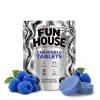
It's reasonable to ask about unwanted effects before you try a supplement. A bright package or a plant-based ingredient doesn't make that question less important.
For Kanna, the useful answer starts with a limit: small studies of particular standardized extracts provide some tolerability information, but they don't establish that every product is free of side effects. Your health, medication, and the full formulation need their own consideration.
What has actually been reported?
A 2014 pilot study enrolled 21 healthy middle-aged adults and examined the branded Kanna extract Zembrin. Its safety reporting recorded symptoms including gastrointestinal discomfort, nausea, and vomiting during extract treatment. The paper described overall tolerability favorably, but a favorable summary doesn't mean nobody experienced symptoms.
The researchers reported that gastrointestinal discomfort resolved spontaneously and did not attribute a direct causal link to the extract. That detail matters: a symptom occurring during a study isn't automatically proven to have been caused by the study product.
The study's small size also matters. It cannot provide a reliable frequency estimate for all users or all Kanna products. It wasn't designed to establish safety across pregnancy, medical conditions, medication combinations, or years of use.
A tolerability result has boundaries
Research participants are selected under eligibility criteria. In this pilot study, people with various significant medical conditions were excluded, as were pregnant participants. That means its results shouldn't be stretched to groups it didn't study.
The study also tested a specific extract and formulation. A product with a different extract, concentration, or additional ingredients may not have the same profile. Even a similar-looking capsule or tablet isn't proof of equivalence.
“Well tolerated in this small trial” is a narrower statement than “safe for everyone.” Keeping the distinction clear makes the evidence more useful.
Read the whole ingredient list
If a product combines Kanna with other active ingredients, unwanted effects or interactions may involve more than the plant. Don't evaluate the package by the headline ingredient alone.
Flavors, sweeteners, coatings, and other formulation ingredients can also matter to people with allergies or dietary restrictions. Check the full label and contact the manufacturer when the information you need isn't available.
Our format guide explains why a tablet, gummy, or powder doesn't tell you the whole recipe.
Medication deserves a separate check
Researchers have described serotonin-transporter activity for a standardized Kanna extract. That creates a reason to review possible interactions with a clinician or pharmacist, especially if you take medicines that affect serotonin.
It does not give us a measured risk for every Kanna-and-medication combination. A theoretical concern and a documented clinical interaction are different kinds of evidence. When combination data are limited, the sensible response is professional review—not assuming that the combination is safe.
Don't stop or change a prescribed medicine to make room for a supplement. Bring the full product label to the conversation. Our interaction guide covers useful questions to ask.
What to do if you feel unwell
If you develop unwanted symptoms after taking a supplement, don't take more to see whether the problem settles. Contact a healthcare professional for advice and keep the packaging available so they can review the ingredients.
Severe symptoms need urgent assessment. Trouble breathing, fainting, severe confusion, or rapidly worsening illness aren't situations to troubleshoot with an online review. In the United States, call 911 for a medical emergency.
Be specific when you speak with a clinician: which product, when you took it, what symptoms appeared, and which medications or other substances were involved. That information is more useful than the plant name alone.
Questions worth asking before use
- Does the label explain every active ingredient and the serving information?
- Are warnings and restrictions easy to find?
- Does my medication or medical history raise concerns?
- Am I relying on a study of this formulation or a different extract?
- Is any safety claim more certain than the evidence supports?
If you're pregnant, breastfeeding, or managing a health condition, don't use small studies in selected healthy adults as reassurance. Seek advice specific to your situation. Kanna supplements are not a substitute for diagnosis or treatment.
Common questions
Does “natural” mean no side effects?
No. Plant-derived substances can be biologically active, and the rest of a formulation may matter too.
Can I use a study's symptom percentages as my personal risk?
No. A small trial of one extract can't give a dependable risk estimate for a different product or individual.
Does feeling fine mean there are no interactions?
No. A noticeable symptom isn't required for every interaction or health concern. Check medication questions before considering use.
References
- Chiu et al. (2014). Proof-of-Concept Randomized Controlled Study of Cognition Effects of the Proprietary Extract Sceletium tortuosum (Zembrin) Targeting Phosphodiesterase-4 in Cognitively Healthy Subjects.
- Terburg et al. (2013). Acute Effects of Sceletium tortuosum (Zembrin), a Dual 5-HT Reuptake and PDE4 Inhibitor, in the Human Amygdala and its Connection to the Hypothalamus.